
SOUTH JERSEY'S PREMIER HBOT FACILITY
Hyperbaric Oxygen Therapy
More oxygen. More pressure. More healing power. HBOT floods your tissues with up to 15 times the normal oxygen concentration — driving cellular repair, reducing inflammation, and triggering recovery at a depth no other therapy can reach.
1.3-3.0 ATA
IBUM Certified Clinicians
Safety Director On-Site
Hard Chambers - Medical O2
Supported Conditions
120+
150%
Max O2 Increase (Room Air)
15
O2 Increase w/ Pure O2
42"
Chamber Diameter
3.0
Max ATA Pressure
THE SCIENCE
How Hyperbaric Oxygen Therapy Works
HBOT is deceptively simple in concept and profound in effect. By breathing oxygen in a pressurized environment, your body absorbs far more than it ever could at normal atmospheric pressure — and that surplus oxygen becomes the raw material for accelerated recovery.
Under normal conditions, oxygen is carried almost exclusively by red blood cells. At pressure, however, oxygen dissolves directly into the blood plasma — reaching tissues, fluids, and areas of poor circulation that red blood cells simply cannot access. This is Henry's Law of gas solubility, and it is the entire mechanism behind HBOT's remarkable range of applications.
When oxygen-starved tissues suddenly receive a flood of dissolved O₂, a cascade of biological responses is triggered: new blood vessels form (angiogenesis), stem cells mobilize from bone marrow, inflammation decreases, bacteria are destroyed, and mitochondria produce more ATP — the cellular energy currency that powers every repair process in the body.
This is why HBOT has clinical applications across such a wide range of conditions — from TBI and stroke to wound closure, Lyme disease, and sports recovery. It is not addressing a specific disease. It is restoring the body's own capacity to do what it was designed to do. The benefits don't stop when you exit the chamber either — the oxygen-enriched environment continues to drive cellular repair for hours afterward, and the cumulative effect of multiple sessions builds progressively over time.
PRESSURE PROTOCOLS
Low, Mid & High Pressure HBOT
Not all HBOT is the same — and not all conditions respond to the same pressure. Through years of clinical observation and data tracked with our custom HBOT Dive Master Pro software, we have identified distinct therapeutic windows at each pressure level. We offer the full range — one of the very few facilities in South Jersey that does.
1.3
ATA - 4 PSI - Mild HBOT
Brain & Neurological Support
Our clinical data consistently shows mild pressure is the sweet spot for neurological conditions. The gentler oxygen saturation appears most effective at crossing the blood-brain barrier, reducing neuroinflammation, and supporting the delicate environment the brain needs to reorganize and recover.
-
TBI, concussion & post-stroke recovery
-
Autism spectrum support
-
Brain fog & Long COVID cognitive symptoms
-
Alzheimer's, Parkinson's & dementia support
-
Anti-aging & cognitive longevity
-
PTSD & neurological mood conditions
2.0
ATA - 15 PSI - Mid Pressure HBOT
Body Tissue & Recovery
Mid-range pressure is where we see the strongest results for musculoskeletal and systemic conditions. The increased oxygen dose reaches deeper into tissues, joints, and organs — accelerating structural repair, reducing chronic inflammation, and driving the angiogenesis that rebuilds compromised vascular networks.
-
Post-surgical recovery & wound repair
-
Sports injuries — tendon, ligament, muscle
-
Osteoarthritis & inflammatory joint conditions
-
Diabetic neuropathy & vascular repair
-
Radiation injury & cancer recovery support
-
Chronic fatigue & systemic inflammation
3.0
ATA - 30 PSI - High Pressure HBOT
Infection, Bacteria, & Critical Care
High pressure is where HBOT becomes bactericidal. At 3.0 ATA the oxygen concentration in tissues reaches levels directly toxic to anaerobic bacteria — making this the protocol of choice for serious infection, Lyme disease, decompression sickness, and conditions requiring the most aggressive oxygen dose outside a hospital setting.
-
Lyme disease & chronic bacterial infection
-
Gas gangrene & serious wound infection
-
Decompression sickness & CO poisoning
-
Microbiome rebalancing & gut dysbiosis
-
Stem cell mobilization protocols
-
Complex wound care — diabetic foot ulcers
HBOT Dive Master Pro: We use custom proprietary software to track each client's dive history, pressure response, and outcomes over time — allowing us to refine protocols with data, not guesswork. This level of documentation and clinical oversight is uncommon in private HBOT facilities and reflects our commitment to results you can measure.
OUR EQUIPMENT
A Facility Built for Serious Results
We didn't cut corners on equipment because we can't afford to cut corners on your results. Every component of our HBOT setup was chosen for clinical effectiveness, safety, and longevity — not cost efficiency.


Hard Shell Chamber — 42" Diameter
One of the largest chambers available anywhere. Spacious enough to exercise, stretch, or simply relax without feeling confined. Front-opening for easy entry — no crawling required.


Zero Electronics Inside the Chamber
Our chamber contains absolutely no electronics — no phone lines, no electronic controls, no interior lights. Nothing. Oxygen accelerates the degradation of electronic components in ways that are invisible until they cause a problem. We eliminate the variables that others overlook. Our controls are entirely mechanical — built to last and built safe.

Medical-Grade Oxygen Concentrators
High-pressure medical oxygen concentrators deliver the purity required for clinical-grade sessions — not compressed air or the portable soft chambers found at spas and wellness centers.

IBUM-Certified Clinicians
Every dive is supervised by a clinician certified by the International Board of Undersea Medicine — the gold standard in hyperbaric safety and clinical protocol.

Safety Director On-Site — Every Session
A dedicated Safety Director is present for every session. This fire safety and clinical oversight role is frequently overlooked at other facilities. We exceed the published safety standards — and then ask our team to exceed those further by deeply understanding their individual role in your safety.
We Never Leave Your Side
Whether this is your first dive or your fiftieth, our clinician stays with you for the entire session — monitoring, guiding, and communicating through the chamber window. Industry data is clear: the overwhelming majority of HBOT incidents result from operator error. We hold our clinicians and technicians to the highest published standards — and then ask them to exceed those by developing a deep personal understanding of their individual role in your safety. A Safety Director is on-site for every session.
-
Full medical history review before your first session
-
Pre-dive safety check every session — consistent, thorough, non-negotiable
-
Complete walkthrough of all chamber features and controls before your first dive
-
Emergency release valve inside the chamber — reviewed with every new client
-
Hand signal system established before pressurization
-
Ear equalization guidance throughout the dive
-
No flammable materials, perfumes, or smoke residue permitted
-
Continuous monitoring for the full duration of every dive
-
Approved items inside the chamber: books, headphones, printed materials

Personal Mask & Mouthpiece
We provide a personal mask or mouthpiece kept on-site and sanitized between every use — ensuring optimal oxygen delivery and maximum comfort for your dive.
YOUR FIRST SESSION
What to Expect on Your First Dive
Most people are nervous before their first session. That's completely normal — and completely unnecessary. If you've ever flown in an airplane, you have already experienced pressurization. This is the same principle, done gently, with someone next to you the whole time.


Medical History & Goals Review
Before anything else, your IBUM-certified clinician sits with you to review your medical history, current conditions, goals, and expectations. This conversation shapes your entire protocol — it is not a formality, it is the foundation of your plan.
Safety Orientation & Pre-Dive Check
Your clinician walks you through everything before you ever enter the chamber — the do's and don'ts (no flammable devices, perfumes, or smoke residue), all the chamber features and controls, the emergency release valve located inside the chamber, and the hand signals used to communicate through the window during the dive. We cover all of this thoroughly on your first visit so that every subsequent session feels completely familiar. We conduct a safety check every single session — not because we don't trust you, but because we take safety seriously enough to be consistent about it every time.
Every session. Every time. No exceptions.
Getting Comfortable
You enter the chamber — spacious enough to sit up, stretch out, or exercise — and settle in however works best for you. Bring a book or printed materials. Listen to guided meditation, binaural beats, or solfeggio frequencies through your headphones to enhance relaxation and direct blood flow to the areas that need it most. We'll guide you through breathwork exercises designed to maximize your oxygen saturation during the dive. Or simply close your eyes and rest — we'll keep the lights low and monitor you just the same. However you spend your time in the chamber, we are right there with you.
Pressurization & The Dive
The chamber pressurizes gradually. You'll feel mild ear pressure — your clinician will guide you through yawning, swallowing, or the Valsalva maneuver to equalize. This is the most common adjustment point for new divers and passes quickly. Once at depth, you simply breathe normally and let the oxygen do its work.
Ear pressure is normal and temporary — just like descending in an airplane.
Depressurization & Post-Dive
At the end of your session the pressure is slowly released. Most people feel relaxed, clear-headed, and energized after a dive. Some feel tired — which is simply your body redirecting energy toward repair. Both responses are normal. Your clinician will check in with you and note any observations for your ongoing protocol.
WHAT YOU BREATHE
Room Air vs. Pure Oxygen
We offer two oxygen delivery options depending on your protocol and goals. Your clinician will recommend the right choice based on your condition, pressure level, and desired outcomes.
+30%
Room Air
Breathing standard room air (21% oxygen) at pressure still increases your oxygen uptake by approximately 30% due to Henry's Law. This is an effective option for general wellness, performance recovery, mild neurological support, and clients who are new to HBOT or working with lower pressure protocols.
15×
Pure Oxygen (O₂)
Breathing 100% medical-grade oxygen at pressure can increase your blood oxygen concentration by up to 15 times normal levels. This is the standard for wound care, serious neurological conditions, Lyme disease, post-surgical recovery, and any condition where maximum oxygen delivery is the goal. We provide a personal mask or mouthpiece sanitized between every use.
A note on soft chambers: You may have seen portable soft-shell hyperbaric chambers marketed online or at wellness spas. These devices typically max out at 1.3 ATA breathing room air — a useful entry-level option, but fundamentally different from what we offer. Our hard chamber reaches 3.0 ATA with medical oxygen — delivering a clinical-grade dose that soft chambers simply cannot match. If you've tried HBOT elsewhere and didn't see results, the equipment and the protocol may be the reason.
YOU'RE IN GOOD COMPANY
Athletes, Veterans, & Public Figures Who Use HBOT
We don't lead with celebrity stories — we lead with research. But it is worth knowing that some of the most performance-focused people in the world have made HBOT a cornerstone of their recovery.
Joe Namath
NFL Hall of Famer · HBOT Advocate
After suffering 5+ concussions during his career, Namath credits HBOT with helping him regain cognitive function, get off pain medication, and stop drinking. He has become one of sport's most vocal advocates for HBOT coverage for athletes and veterans with TBI and PTSD.
ESPN Feature Story →


LeBron James
NBA · Performance Recovery
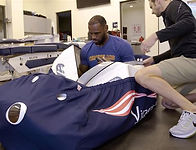
James is well-documented for his commitment to recovery technology. He travels with a portable soft chamber to away games — a testament to how seriously elite athletes take HBOT as a tool for maintaining performance across a long season.
Justin Bieber
Artist · Lyme Disease Recovery
Bieber publicly shared his Lyme disease diagnosis and his use of HBOT as part of his recovery protocol — bringing significant mainstream attention to HBOT's role in managing chronic tick-borne illness and its associated neurological symptoms as well as reducing other toxins in the body.

*Referenced for educational purposes only. Individual results are not a guarantee of outcomes for any person.
THE RESEARCH
Evidence, Not Just Anecdotes
While well-known faces open the conversation, it's the clinical research that drives our protocols. Below are selected studies that directly inform how we use HBOT — with links to the full publications so you can read them yourself.
TBI / Concussion · PubMed
HBOT Can Improve Post-Concussion Syndrome Years After Mild TBI
This randomized prospective trial demonstrated that brain injuries sustained 1–5 years prior still showed measurable improvement in cognitive function and quality of life following a structured HBOT protocol — evidence that the window for neurological recovery is longer than previously assumed.
Read on NIH / PubMed →
Tendon Recovery · PubMed
Low-Pressure HBOT Improves Recovery Markers in Tendon Injuries
A 2017 study showed that mild HBOT (1.25 ATA) applied early in tendon recovery effectively prevents hypoxia in damaged tissue and improves macrophage activity — supporting low-pressure HBOT as a valuable tool in soft tissue recovery protocols.
Read on NIH / PubMed →
Anti-Aging · Brain Function · Dr. Shai Efrati
HBOT Reverses Aging Markers & Improves Cognitive Function Through Angiogenesis
Dr. Shai Efrati — one of the world's leading HBOT researchers — has published extensively on HBOT's ability to stimulate new blood vessel growth in the brain, improve cognitive scores in healthy aging adults, and reverse micro-damage that accumulates silently over time.
Watch Dr. Efrati's Lecture →
THE RESEARCH
Long COVID & Post-Viral Recovery
The research on HBOT's role in Long COVID recovery is among the fastest-growing areas in the field. Multiple clinical trials have demonstrated significant improvements in cognitive function, fatigue, and quality of life.
PubMed · 2021
Early Evaluation: HBOT for Long COVID Fatigue & Brain Function
A 2021 study showed significant improvements in Long COVID fatigue and cognitive function — an early but compelling signal that prompted further investigation into HBOT as a post-viral recovery tool.
Read the Study →
Randomized Controlled Trial · Dr. Efrati
HBOT Improves Neurocognitive Function in Post-COVID Condition Dr. Shai Efrati's randomized controlled trial demonstrated that HBOT meaningfully improved neurocognitive function and reduced symptoms in individuals with persistent post-COVID syndrome.
Read the Study →
NYU Study · Respiratory Distress
HBOT for COVID Respiratory Distress — An Alternative to Ventilation
An NYU study examined COVID individuals given HBOT instead of ventilation, raising important questions about earlier intervention in respiratory deterioration and pointing to HBOT as a meaningful clinical option.
Read the Study →
Nature · Cardiac Function · 2023
HBOT's Effect on Myocardial Function in Post-COVID Syndrome
A 2023 randomized controlled trial published in Scientific Reports examined how HBOT affects heart muscle function in post-COVID individuals — an important consideration given the cardiovascular toll of both the illness and vaccine-related complications.
Read on Nature →
Do you have Long COVID symptoms? Fatigue, memory issues, brain fog, body aches, digestive issues, and shortness of breath affect approximately 50% of COVID survivors at six months. These are precisely the symptoms the HBOT research addresses most directly. Call us to discuss whether an HBOT protocol makes sense for your situation.